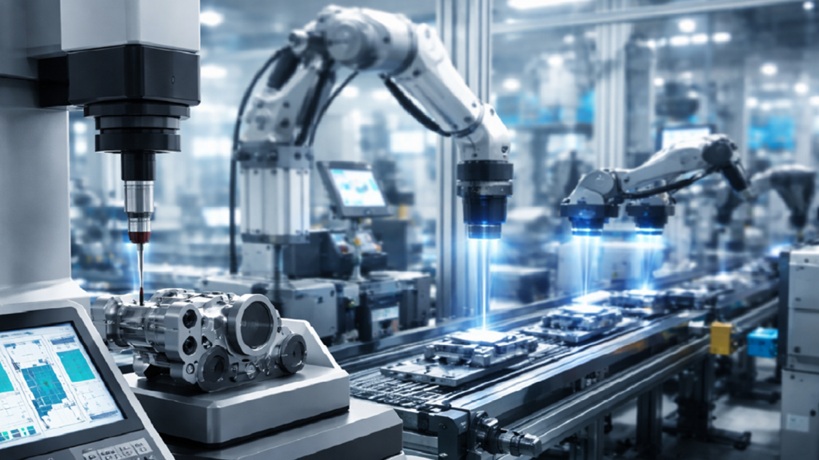
AMT additive manufacturing gives engineers a direct path from digital design to finished metal parts, cutting weeks off traditional production timelines while holding tolerances that satisfy the most demanding industrial applications. As global supply chains shift toward regionalised production and faster iteration cycles, additive processes have moved from laboratory curiosities to mainstream production tools.
How Additive Manufacturing Works
Additive manufacturing builds parts layer by layer from metal powder or wire feedstock, guided by a 3D digital model. Unlike subtractive methods that cut material away from a solid block, additive processes deposit or fuse material only where the design requires it. This approach eliminates much of the waste associated with CNC machining and opens geometric possibilities that conventional tooling cannot reach.
Key Additive Technologies
Several technologies fall under the additive umbrella:
- Selective laser melting uses a high-power laser to fuse fine metal powder in a bed, producing fully dense parts in stainless steel, titanium, Inconel and aluminium alloys.
- Binder jetting applies a liquid binding agent to powder layers, then sinters the resulting green body in a furnace.
- Directed energy deposition feeds wire or powder into a melt pool created by a laser or electron beam, suited to building large structures or repairing worn components.
Each technology has a performance envelope defined by build volume, resolution, surface finish and material options. Selecting the right process requires matching these parameters to the part’s functional requirements and production volume.
Applications Across Industries
Additive manufacturing serves sectors where complexity, weight reduction or rapid turnaround outweigh the per-unit cost advantages of conventional mass production.
Aerospace and Defence
In aerospace, engineers print turbine blades with internal cooling channels that would be impossible to machine. These channels improve thermal management and extend component life, translating directly into fuel savings for airline operators. Airbus and Boeing have both certified additively manufactured structural brackets for commercial aircraft programmes.
Medical Devices
Medical device makers use AMT’s additive capabilities to produce patient-specific surgical guides, custom implant prototypes and fixture tooling for cleanroom assembly lines. A surgeon planning a complex spinal fusion can review a 3D-printed anatomical model of the patient’s vertebrae before entering the operating theatre, reducing operative time and improving placement accuracy.
Industrial Equipment
Industrial equipment manufacturers print replacement parts for legacy machines whose original tooling no longer exists. Rather than reverse-engineering a casting pattern and commissioning a short-run foundry pour, a maintenance engineer can scan the worn part, model the replacement and have a functional component in hand within days.
As Mr Lim Kok Kiang, former Assistant Managing Director of the Singapore Economic Development Board, noted, “Singapore’s investment in additive manufacturing positions our precision engineering sector to capture high-value work that demands both speed and quality.”
AMT’s Additive Manufacturing Capabilities
AMT operates additive manufacturing systems alongside metal injection moulding, ceramic injection moulding and CNC machining lines at its Singapore facility. This breadth of process capability allows the company to recommend the most cost-effective production route for each project rather than forcing every design through a single technology.
Prototyping Support
For prototyping engagements, AMT’s engineers work with clients to optimise part orientation, support structures and build parameters. These decisions affect surface finish, dimensional accuracy and residual stress in the finished component. Getting them right at the prototype stage prevents costly iteration during production scale-up.
Production Quality Assurance
For production runs, AMT applies the same quality management disciplines used across its medical device and industrial manufacturing operations. Incoming powder characterisation, in-process thermal monitoring and post-build inspection using coordinate measuring machines and CT scanning ensure every part meets specification.
The company also performs secondary operations on additively manufactured parts, including:
- Heat treatment and hot isostatic pressing
- Surface grinding and electropolishing
These steps relieve internal stresses, close residual porosity and achieve the surface finishes required for functional or aesthetic applications.
Material Science Behind the Process
Material selection drives part performance. Key alloys include:
- Stainless steel 316L for corrosion resistance in marine and chemical processing equipment
- Titanium Ti-6Al-4V for high strength at low weight in aerospace and medical implant applications
- Nickel superalloys such as Inconel 625 and 718 for extreme temperatures found in turbine engines and exhaust systems
Powder Quality and Processing
Powder quality matters as much as alloy selection. Particle size distribution, morphology and flowability affect how evenly each layer spreads, which in turn determines part density and mechanical properties. AMT sources powder from qualified suppliers and tests each lot before loading it into the build chamber.
Post-processing heat treatments, tailored to each alloy, optimise grain structure and mechanical behaviour. A titanium aerospace bracket may require stress relief at 600 degrees Celsius, while a nickel superalloy combustor liner needs a full solution anneal followed by age hardening.
Comparing Additive to Conventional Methods
Additive manufacturing does not replace machining or injection moulding in every scenario. High-volume production of geometrically simple parts remains more economical through conventional routes. Where additive excels is in low-to-medium volumes, complex geometries, rapid design changes and situations where tooling lead time would delay market entry.
A break-even analysis typically considers unit cost, tooling amortisation, lead time value and inventory carrying cost. For medical device prototypes needed in quantities of ten to fifty, additive manufacturing often wins on total cost of ownership even if the per-part price exceeds that of a moulded equivalent.
Getting Started With AMT
Engineers evaluating additive manufacturing for a new project can engage AMT’s applications team for a design-for-additive review. The team assesses geometry, material requirements, tolerances and production volumes, then recommends a process path that balances cost, quality and lead time.
From single prototypes to serial production, AMT additive manufacturing provides a reliable route to high-precision industrial parts that meet the tightest engineering standards.


Leave a Reply