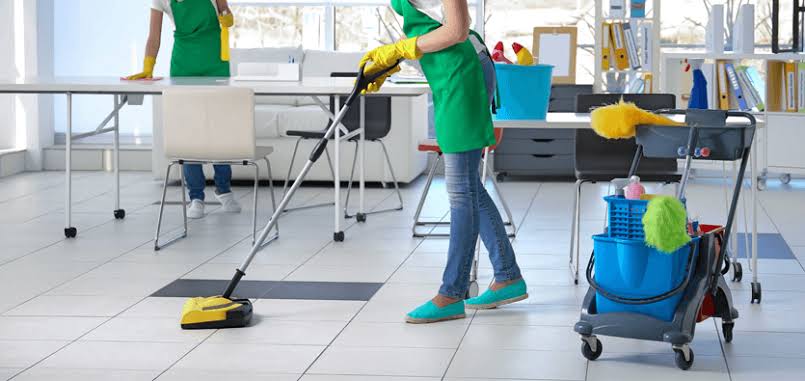
Plenty of small and mid-sized businesses handle cleaning informally a staff member tidies, someone empties the bins, a part-time cleaner comes in twice a week. It works until the business grows, until an occupant complains, or until an inspection asks for records nobody has. The argument for why hire a commercial cleaning service rests less on the cleaning itself than on everything that surrounds it: consistency, compliance, liability and the value of staff time.
The Real Cost of Doing It Informally
The informal arrangement looks free because nobody invoices for it. In practice it consumes staff time at full salary cost on work outside their role, produces inconsistent results that depend on who is available, and stops entirely when the person responsible is on leave. It also carries employment obligations if someone is engaged directly, along with responsibility for their training, equipment and safety. Costed honestly, the informal option is rarely as cheap as it appears and never as reliable.
Consistency Is the Core Benefit
A professional arrangement delivers the same work at the same frequency regardless of who is on leave, because cover is the provider’s problem rather than yours. That consistency is what occupants actually notice not an exceptional clean occasionally, but washrooms that are stocked every day, bins emptied every evening and pantries that never become an issue. Standards maintained continuously also cost less than standards restored periodically, because nothing accumulates to the point of requiring intervention.
Equipment and Method You Would Not Buy
Commercial providers use equipment that no individual business would justify purchasing: floor scrubbers, extraction machines, high-filtration vacuums, access equipment for high-level work. Vacuum filtration in particular matters more than most people realise a poorly filtered machine redistributes fine dust rather than removing it, which is a common and invisible cause of complaints about air quality. Providers also bring method: colour-coded equipment to prevent cross-contamination, correct dilution and contact times for disinfectants, and sequences that avoid re-soiling cleaned areas.
Health Outcomes Rather Than Appearance
Tidiness and hygiene are different things, and the gap between them is where illness transmission happens. Door handles, lift buttons, shared equipment, pantry taps and meeting room controls carry contamination between many people daily, and disinfecting them properly requires knowing that disinfection follows cleaning and that contact time matters. A specified touch point regime, delivered consistently, reduces transmission in a way that general tidying does not. Providers of professional office cleaning services build this into the schedule rather than leaving it to whoever has time.
Liability and Compliance
This is the argument that usually persuades a finance director. A professional provider carries public liability and workers’ compensation insurance, trains staff in chemical handling, maintains safety data sheets and method statements, and produces records of what was done and when. If an incident occurs a slip, an exposure, a hygiene complaint that documentation demonstrates due diligence. An informal arrangement produces none of it, and reconstructing a defence after the fact is considerably harder than maintaining a record as you go.
Getting Staff Time Back
Every hour an employee spends cleaning is an hour not spent on the work they were hired for, charged at their salary rate rather than a cleaning rate. For small teams this is a genuine drag on capacity, and it is usually invisible because it never appears as a line item. Quantifying it headcount involved, hours weekly, loaded cost often shows that outsourcing is close to cost-neutral before considering any of the other benefits.
Scaling Without Renegotiating Everything
Businesses change: floors are added, headcount rises, a second site opens, occupancy patterns shift with hybrid working. A contract arrangement adjusts by varying the specification and frequency. An informal arrangement has to be rebuilt each time, usually under time pressure. This matters most during growth, which is precisely when nobody has capacity to think about cleaning.
What to Look For
The differentiators are staffing and supervision rather than price. Ask whether cleaners are directly employed or subcontracted, since employed staff learn a site and stay. Ask how supervision works and how often a supervisor attends. Ask about absence cover. Ask what equipment is provided and how it is maintained. And ask for a written specification rather than a general description. Reviewing the types of commercial cleaning services available first helps ensure the specification covers periodic work rather than only the daily routine.
Making the Decision
The threshold is usually a combination of premises size, headcount and regulatory exposure. A small office with a handful of staff may reasonably manage informally. A business with multiple rooms, a pantry, washrooms serving dozens of people, visiting clients or any regulated activity has crossed the point where informal arrangements produce inconsistent results and unmanaged risk. Recognising that transition before a complaint or an inspection forces it is the cheaper way to arrive at the same conclusion.
Making the change is less disruptive than most businesses expect. A provider surveys the premises, proposes a specification and frequency, and starts on an agreed date. The main input required is deciding where standards genuinely matter which usually turns out to be washrooms, pantries and anywhere clients are received and being willing to say so plainly rather than asking for everything at the same level.


Leave a Reply